
Social listening is one of the few marketing practices that pays for itself within 90 days, even on an account with a small media budget. Not because it generates direct leads (it does not). Because it reveals what your brand cannot otherwise see: what real customers say in DMs, in a competitor's comments, in a private group, in a review, in a post that never tagged you.
Most companies that say they "do social listening" only do monitoring, which is a different thing (cheaper, and less useful). Monitoring counts mentions. Listening interprets them. Whoever only counts never acts. Whoever interprets acts, and acts early.
This article covers what social listening actually is, how it differs from monitoring, the 5 tools that dominate the North American market in 2026, our 4-stage process and the 3 KPIs that matter.
What social listening is
Social listening is the structured practice of capturing, classifying and acting on mentions of your brand, product, competitor and category across every digital platform. It goes beyond counting how many times your name appeared. It measures what is being said, with what sentiment, in what context, by whom, and what action that calls for.
The concept has three layers, each with a different job:
- Capture · crawling the networks (Twitter/X, Instagram, TikTok, Reddit, Google and BBB reviews, blogs, forums, transcribed podcasts)
- Classification · sentiment (positive, negative, neutral), theme category (price, support, product, brand), risk (routine, attention, crisis)
- Action · a direct reply, a product adjustment, a communication change, activating a crisis protocol
Missing any of the three, it becomes cold monitoring. With all three, it becomes operational intelligence.

Social listening vs social monitoring: the difference that changes everything
A lot of software sold as "social listening" is, in practice, monitoring with a better name.
| Dimension | Monitoring | Listening |
|---|---|---|
| What it measures | Mention count | Content + sentiment + context |
| Frequency | Real time or a dashboard | Periodic analysis + exception alerts |
| Output | An aggregate number | An actionable insight + a proposed action |
| Typical coverage | Platforms where the brand is literally mentioned | Platforms + related terms + category + competitors |
| Who runs it | An intern, an automatic tool | A senior analyst + a tool |
| Monthly investment | $150 to $1,200 | $2,000 to $15,000 |
| Expected ROI | Reactive (responds when something appears) | Proactive (anticipates trends, avoids crises) |
Quick diagnosis: if your "social listening operation" delivers a monthly report with a bar chart and a mentions table, it is monitoring. If it delivers a document with a critical reading of what appeared, a hypothesis about why, and a proposed action for the coming weeks, it is listening.
The choice is not technical. It is about operational maturity. A small company typically starts with monitoring and evolves into listening as it grows. A large company with high reputational risk cannot operate without listening.
The 5 tools that dominate the North American market in 2026
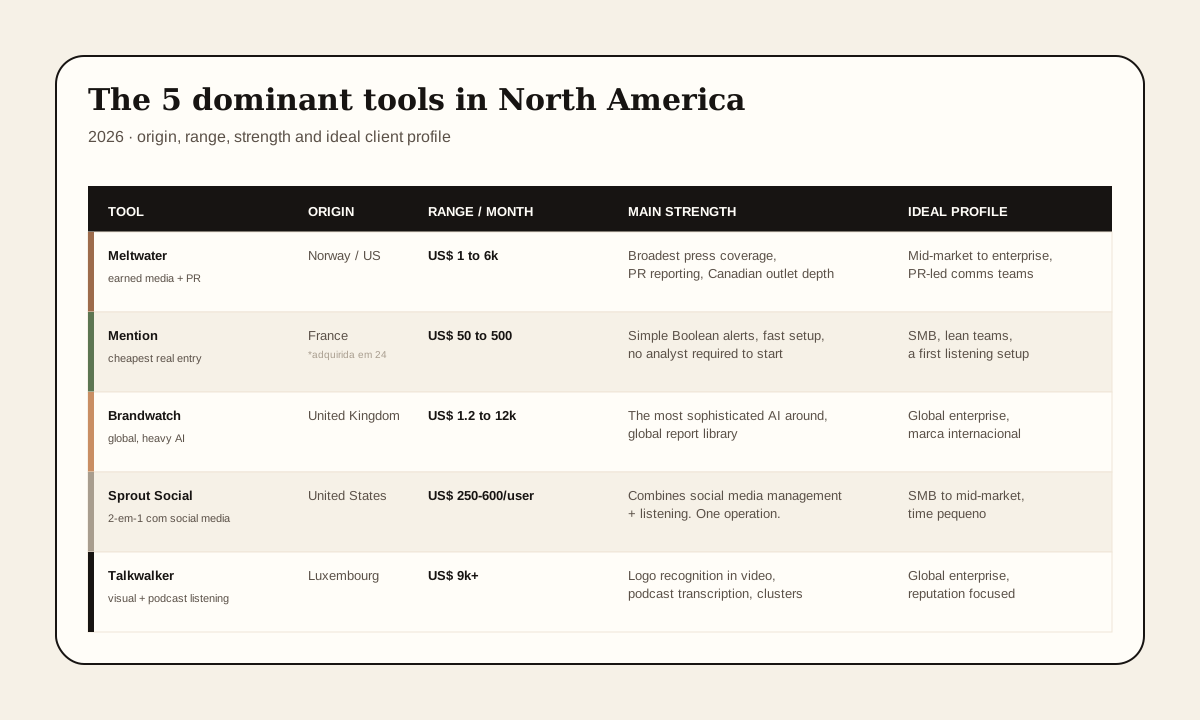
Meltwater
Origin: Norway / US. For whom: mid-market to enterprise, PR-led communications teams. Price range: US$1,000 to US$6,000/month. Strong at: the broadest press coverage of the set, including depth in Canadian outlets, earned-media reporting that a comms team can hand to an executive, and integration between PR and social in one view. Weak at: social sentiment AI trails the dedicated players. If your use case is purely social conversation analysis, you are paying for a press-clipping engine you will underuse.
Mention
Origin: France. For whom: SMB, lean teams, a first listening setup. Price range: US$50 to US$500/month. Strong at: the cheapest real entry point in the category. Boolean alerts that a marketer can configure without an analyst, fast setup, sane pricing for a business that is not yet ready for enterprise tooling. Weak at: shallow historical data and limited analysis. It tells you something happened; it does not tell you what it means.
Brandwatch
Origin: United Kingdom (now owned by Cision). For whom: global enterprise, brands with international presence. Price range: US$1,200 to US$12,000/month. Strong at: the most sophisticated AI analysis on the market, a library of pre-built reports, integration with global platforms (TikTok International, Reddit, gaming forums, Twitch). Weak at: price and learning curve. For a brand operating in one metro area, you pay dearly for what you will not use.
Sprout Social
Origin: United States. For whom: SMB to mid-market, focused on social media management + listening. Price range: US$250 to US$600/month per user. Strong at: combining social media management (publishing, support, calendar) with listening. One operation instead of two tools. Weak at: pure listening stays shallow compared with dedicated tools. It works if the use case is "primarily social media management with incidental listening".
Talkwalker
Origin: Luxembourg. For whom: global enterprise, brands focused on media analysis + reputation. Price range: US$9,000+/month (no smaller tier published, billed annually). Strong at: visual listening (recognizing your logo in an image or video, even with no text). Podcast analysis with automatic transcription. A unique "Conversation Clusters" feature that groups themes semantically rather than by keyword. Weak at: high price, heavy learning curve, and underuse in a small team.
How to choose: a decision tree
A short answer based on an operational diagnosis:
You are an SMB, one market, marketing budget up to $10k/month: Mention to start, Sprout Social if you also need publishing.
You are mid-market with medium/high reputational risk, budget above $20k/month: Meltwater if the pressure is on earned media and PR; Brandwatch if it is on social conversation.
You are a brand with international operations across multiple countries: Brandwatch or Talkwalker.
You have a small team and want one tool combining social media plus light listening: Sprout Social.
You are not ready for a tool: start with free Google Alerts plus a spreadsheet. For 60 days. If it becomes a real pain, move up to Mention.
The Koko social listening process in 4 stages
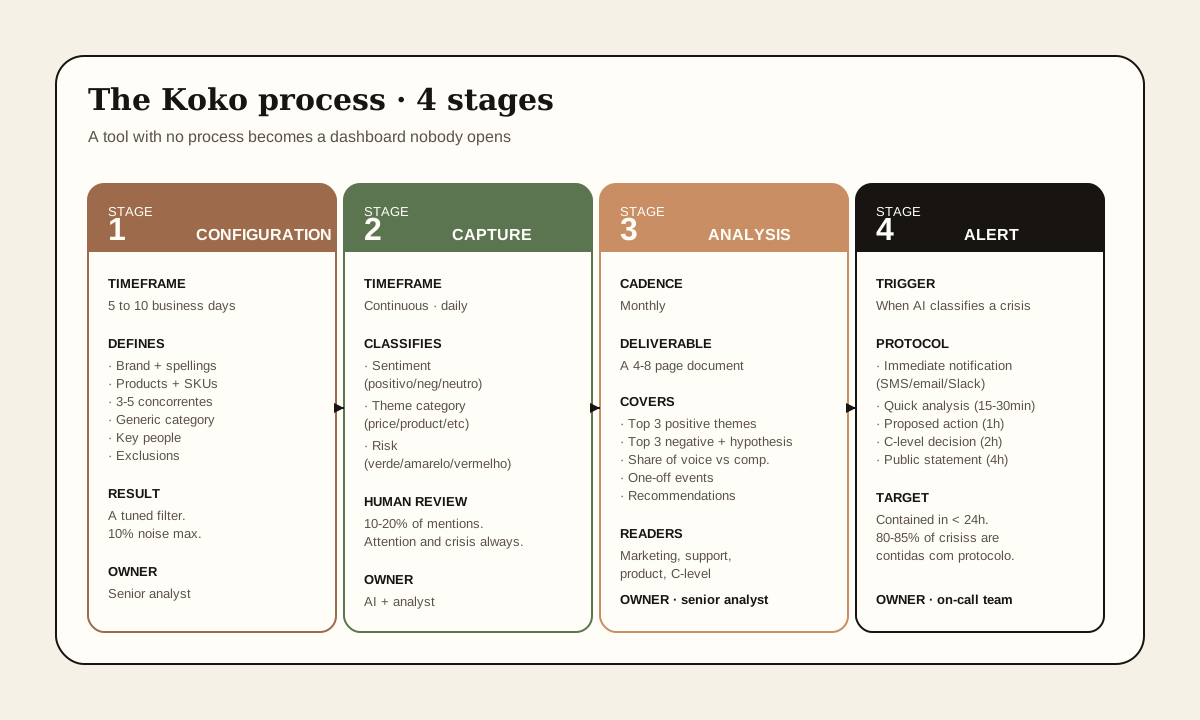
The tool alone generates nothing. The process is what separates "we have Meltwater" from "we use Meltwater". Four stages running on a monthly cycle.
Stage 1: configuring terms and exclusions
Defines what you want to hear. It is not just the brand name. It includes:
- Brand: name + spelling variations + nicknames (customers rarely write the name correctly)
- Product: the main SKUs or services (each as a separate term)
- Competition: 3 to 5 direct competitors
- Category: generic niche terms (without the brand name)
- Key people: CEO, spokespeople, founders
- Exclusions: filters that cut noise (homonyms, brands in other niches with the same name)
A badly built configuration captures 40% noise. A good one, 10%. That difference is what separates a useful report from an ignored one.
Stage 2: continuous capture and classification
Runs in the background daily. Classification weighs 3 dimensions:
- Sentiment: positive, negative, neutral
- Theme category: price, support, product, brand, delivery, etc.
- Risk: routine (green), attention (yellow), crisis (red)
Most tools do this with AI. There is always human review on 10-20% of mentions, mainly those the AI flagged as "attention" or "crisis", to avoid false positives (which burn the system's credibility).
Stage 3: monthly analysis + critical reading
It is not a dashboard. It is a document written by an analyst, with:
- Top 3 positive themes with a real example
- Top 3 negative themes with a real example and a hypothesis of cause
- A share of voice comparison against competitors
- One-off events that moved the curve (a launch, a campaign, a crisis)
- Specific recommendations for the coming weeks (a communication adjustment, an alert for the support team, a product action)
A 4 to 8 page document. Read by marketing + support + product + C-level. Each proposed action has a named owner and a deadline.
Stage 4: exception alert (24h or less)
Something gets classified as a "crisis" (strongly negative sentiment, growing volume, on a large-reach platform). That fires a protocol:
- Immediate notification to the on-call team (SMS, email, Slack)
- Quick analysis (15 to 30 minutes) to understand the scope
- A proposed action within 1 hour
- A C-level decision within 2 hours
- A public statement within 4 hours, if needed
Brands with a well-drilled protocol contain the large majority of crises in under 24 hours. Brands without one take days to respond, and the damage grows in that interval.
The 3 KPIs that matter
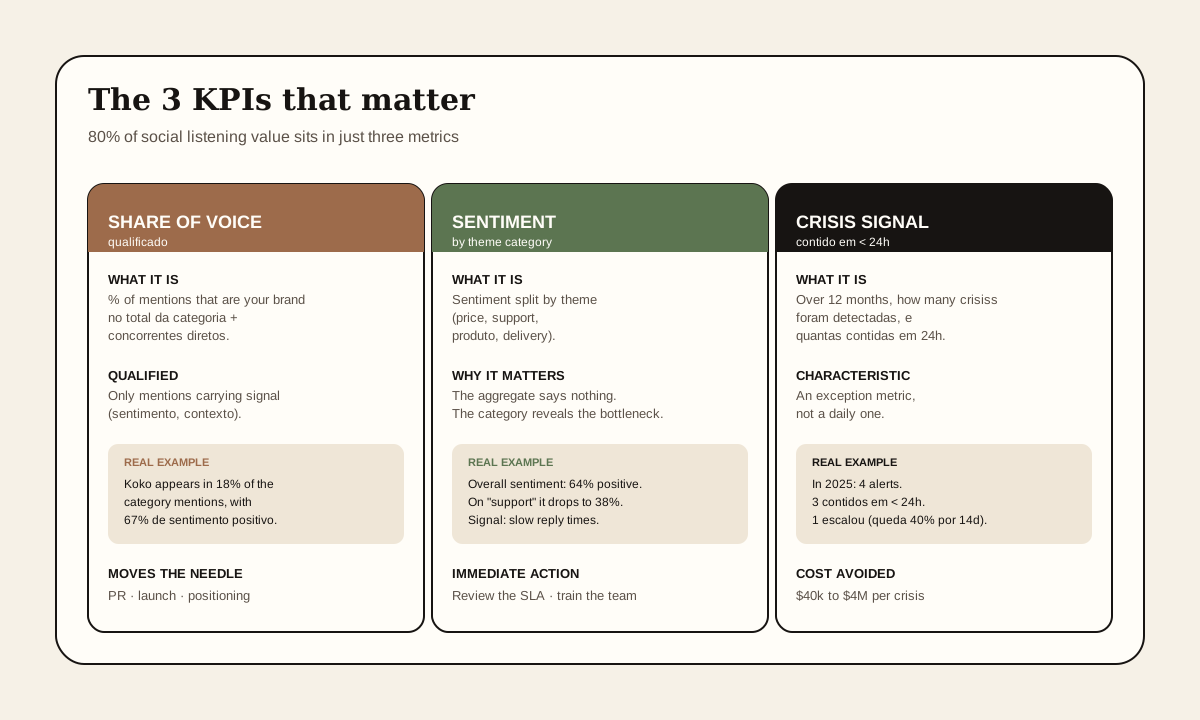
Listening produces a lot of data. Most of it is noise. Three metrics hold 80% of the value.
1. Qualified share of voice
How many mentions your brand gets, divided by total mentions of the category plus direct competitors, over a fixed period. "Qualified" means only mentions carrying some signal (expressed sentiment, relevant context), not a generic name-drop.
Example: "Koko appears in 18% of mentions for 'marketing agency in Metro Vancouver in 2026', with 67% positive sentiment, while Competitor X appears in 23% with 41% positive."
Moves the needle: PR campaigns, launches, positioning.
2. Sentiment by theme category
Aggregate sentiment rarely says anything useful. Sentiment split by theme (price, support, product, delivery) reveals where the bottleneck is.
Example: "Overall sentiment 64% positive. But on 'support' it drops to 38% positive, with 5 negative mentions in 7 days citing slow reply times."
Immediate action: review the support SLA, train the team, before it becomes a crisis.
3. Crisis signal in under 24h
Not a daily metric, an exception metric. Over 12 months, how many times the brand was alerted to an imminent crisis in under 24h, and how many were contained before going public.
Example: "In 2025, 4 crisis alerts. 3 contained in under 24h. 1 escalated to media (40% sentiment drop for 14 days, recovery in 90 days)."
This is the metric that justifies the whole listening investment. An uncontained crisis costs somewhere between $40,000 and several million in brand damage, depending on size. Preventive listening costs $2,000 to $15,000 a month.
When to bring in social listening
Bring it in when:
- Your brand already has organic mention volume (above 200/month across all platforms)
- You operate in a sector with high reputational risk (health, finance, retail, mass-market brands)
- You launched a new product and want the market's real response, not a survey sample
- Competitors are active with a strong digital voice
- You have a support tool (CRM, central messaging) receiving demand from untreated mentions
Do not bring it in when:
- The brand is young with fewer than 50 mentions/month (not enough data yet)
- The budget is tight with no room to hire an analyst alongside
- There is no action protocol (it will become a dashboard nobody opens)
- There is no visible person to respond in a crisis (absent CEO, communications entirely outsourced)
How Koko runs social listening for clients
On projects where social listening is in scope, we run the 4-stage process, with a monthly analysis written by a senior analyst plus a review with the client's internal C-level, and a crisis protocol integrated into the client's own messaging stack.
We do not sell listening standalone. We sell it as part of a communications and marketing operation, because a tool without action becomes dead fixed cost. To assess whether it makes sense for you, worth talking to us or reading communications agency vs marketing agency, which covers when listening belongs to the communications layer and when it belongs to marketing.
FAQ
What is the difference between social listening and social monitoring? Monitoring counts mentions. Listening interprets them. Monitoring delivers a dashboard with an aggregate number. Listening delivers an analysis written by an analyst with sentiment, category, risk and a proposed action. The investments and the results are completely different.
Which social listening tool is best for a Canadian company? For an SMB in one market with a budget up to $10k/month, Mention to start. For a mid-market company with high reputational risk, Meltwater if the pressure is on earned media, Brandwatch if it is on social conversation. For a brand with international operations, Brandwatch or Talkwalker. For a small team combining social media management with light listening, Sprout Social.
What does real social listening cost? The tool runs between $600 and $15,000/month depending on tier. A senior analyst to run it (in-house or agency) between $5,000 and $15,000/month. Total: $6,000 to $30,000/month. Brands budgeting less than that are usually doing monitoring, not listening.
How long until the investment pays off? For brands with reputational risk, it pays on one contained crisis. For brands without that risk, it pays in 6 to 12 months through an actionable product or communication insight that moves an acquisition or retention metric.
Can I do social listening with Google Alerts or a free tool? You can, with severe limitations. Google Alerts only captures text media indexed by Google, missing Instagram, Twitter/X, TikTok and private groups. It works as a starting point for a small brand. Above 200 mentions/month it becomes unworkable.
Should the marketing team run listening in-house or hire an agency? It depends on team size. A team with a dedicated senior analyst can run it in-house. A small team with no analyst will underuse the tool. An agency adds scale (analysts working across multiple clients), but costs more.
How long until the first useful insight? Configuration takes 5 to 10 business days (defining terms, exclusions, training the AI with human review). The first useful report usually arrives between 30 and 60 days, once there is enough baseline for historical comparison.
Conclusion
Social listening is the least glamorous and most underrated marketing function in 2026. It does not generate direct leads. It has no measurable CAC. It does not fit in a media dashboard. But it is one of the only practices that genuinely protects a brand at scale and spots a trend before the competition does.
The difference between running it well and running it badly is not the tool (any of the 5 listed will do to start). It is the process: well-configured terms, a monthly analysis written by a human, a tested crisis protocol, clear KPIs.
Whoever treats listening as a dashboard sees cost. Whoever treats it as operational intelligence sees value.
Read next
- Communications agency vs marketing agency · where listening fits in your operation
- How much a marketing agency costs in Metro Vancouver · fee ranges, including operations with listening
- Custom software vs. off-the-shelf in 2026 · when integrating listening with your own CRM makes sense
Sources and references
- Meltwater · Platform Overview
- Mention · Features
- Brandwatch · Solutions Overview
- Sprout Social · Features
- Talkwalker · Platform Overview
This is Koko's point of view on how to treat social listening in 2026: not as a dashboard, but as operational intelligence. If you want to assess whether it makes sense for your brand, talk to us.